The goal of this paper is to sketch a mediator that enables users an integrated straightforward access to XML document type definitions via ontologies and by employing meta-knowledge, especially constraints, e.g. when working with design tools and other knowledge-based applications that wish to re-use information about Internet resources content and structure. The user formulates goals containing complex combinations of conjunction of atoms, graph-path expressions and additional user-defined constraints on the occurring variables. Queries are expressed using terms from the shared ontology, without having to know about the location or content of context-dependent dynamically changing information resources. Figure  illustrates how a typical query combines constraints of different types:

Figure: Example Query with Constraints
The fundamental question which has to be solved is a semantic matching problem. That is, there is a goal object, the user request, expressed against the terms of a shared ontology, that has to be matched with various information and product offers and services included in distributed Internet resources. A shared ontology is formalised by a set of rules built of feature graphs, containing a set of variables with attached constraints and stored in a knowledge base. Moreover, the knowledge base stores information about DTDs and its locations by non-instantiated facts using feature graphs.
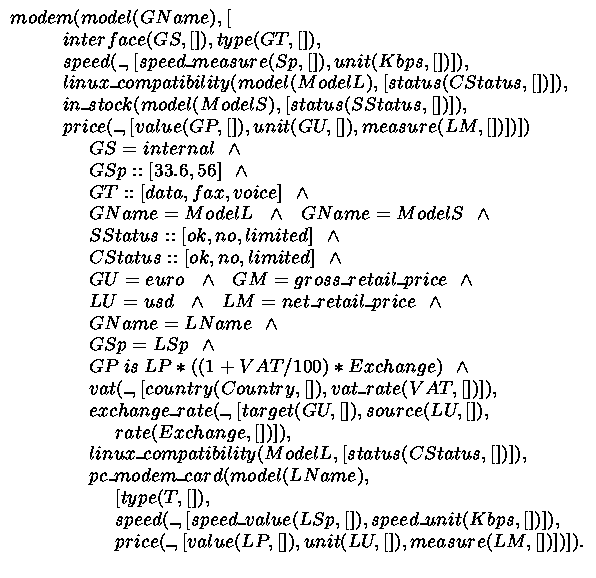
When integrating information from various resources, DTDs and parts of the domain concepts may equal and differ in various syntactic, symbolic and structural aspects such as renaming of symbols, overlap or set containment of attributes and features, and measurement of units, although they share some common semantics or an application objective. Knowledge sharing among parts of the recursively constructed domain concepts and DTDs is operationalised by mediation rules that are expressed by constrained feature clauses. Following examples show how knowledge sharing can be expressed.


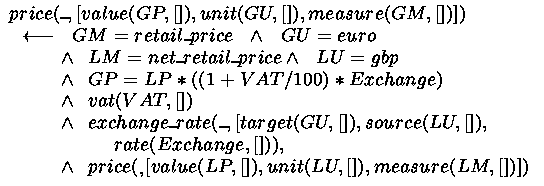
Parts of the recursively structured domain concepts have to be
associated with concrete context-specific information stored in
various XML resources. Starting from some given initial set of
knowledge sharing axioms, mediation rules can be synthesised. The
general idea of the synthesis process is to derive a conjunction of
premises and constraints iteratively by finding equivalent DTDs for
parts of the concept and fusing the constraints. The synthesis process
terminates when the domain concept is decomposed into a set of
subconcepts such that all subconcepts are associated with
DTDs. Figure visualises a synthesis step.

Figure: Generating Rules by Substitution of Equivalent Subgraphs
The synthesis process is guided by the following logical rules.

For example, the generated clause in Figure couples the
context-specific description of a "PC modem card" (cf.\
Figure ) and further information resources with the shared domain model introduced by the ontology.
A mediator shell is realised as a viewpoint that uses various methods for knowledge-based and graph-based reasoning of the SEAMLESS system, and the knowledge-base with shared ontologies, the context-dependent mediation
rules, the facilitator facts about locations and further design knowledge. Employing the proposed representation formats constrained feature graphs and constrained feature clauses, the knowledge base is considered to be a specific constraint logic program. Constraint logic programs contain an inference engine and constraint solvers. Graph selection and application of the built-in reasoning services - such as matching, unification and constraint services - of a constraint-logic language can then be used to efficiently implement basic mediation steps. Applying the proposed framework, the mediation task is achieved rather straightforward and in an automatic way by the following
steps in Algorithmus :
Automated processing of the query in Figure with
respect to the mediator knowledge base in Figure
and accessing the information about the "pc-modem-card" described in
Figure , the exchange rate o.94 for euro against
"usd", "linux-compatibility" and "in-stock", yields X=;SPMquot;Supramax;SPMquot;,
GP=38.44 taking into account the VAT as well. One of the problems
that the mediator architecture addresses is the flexible integration
and transformation of multiple dynamic changing resources into a
re-usable form via a shared ontology. Exploiting the built-in
reasoning and constraint-solving facilities of a constraint-logic
programming language, several tasks as constraint rewriting are done
in an automatic way.