The ICS-FORTH RDFSuite:
Managing Voluminous RDF Description Bases*
|
|
Abstract: Metadata are widely used in order to
fully exploit information resources available on corporate intranets or the
Internet. The Resource Description Framework (RDF) aims at facilitating the
creation and exchange of metadata as any other Web data. The growing number of
available information resources and the proliferation of description services
in various user communities, lead nowadays to large volumes of RDF metadata.
Managing such RDF resource descriptions and schemas with existing low-level
APIs and file-based implementations does not ensure fast deployment and easy
maintenance of real-scale RDF applications. In this paper, we advocate the use
of database technology to support declarative access, as well as, logical and
physical independence for voluminous RDF description bases.
We present RDFSuite, a suite of tools for RDF validation, storage and querying.
Specifically, we introduce a formal data model for RDF description bases
created using multiple schemas. Next, we present the design of a persistent RDF
Store (RSSDB) for loading resource descriptions in an ORDBMS by exploring the
available RDF schema knowledge. Our approach preserves the flexibility of RDF
in refining schemas and/or enriching descriptions at any time, whilst it
outperforms, both in storage volumes and query execution time, other approaches
using a monolithic table to represent resource descriptions and schemas under
the form of triples. Last, we briefly present RQL, a declarative language for
querying both RDF descriptions and schemas, and sketch query evaluation on top
of RSSDB.
1 Introduction
Metadata are widely used in order to fully exploit information resources (e.g., sites, documents, data, images, etc.) available on corporate intranets or the Internet. The Resource Description Framework (RDF) [17] aims at facilitating the creation and exchange of metadata as any other Web data. More precisely, RDF provides i) a Standard Representation Language for metadata based on directed labeled graphs in which nodes are called resources (or literals) and edges are called properties and ii) an XML syntax for expressing metadata in a form that is both humanly readable and machine understandable. Due to its flexible model, RDF is playing a central role in the next evolution step of the Web - termed the Semantic Web. Indeed, RDF/S enable the provision of various kinds of metadata (for administration, recommendation, content rating, site maps, push channels, etc.) about resources of quite diverse nature (ranging from PDF or Word documents, e-mail or audio/video files to HTML pages or XML data) to different target communities (corporate, inter-enterprise, e-marketplace, etc.). The most distinctive RDF feature is its ability to suport superimposed descriptions for the same Web resources, enabling content syndication - and hence, automated processing - in a variety of application contexts. To interpret resource descriptions within or across communities, RDF allows for the definition of schemas [6] i.e., vocabularies of labels for graph nodes (i.e., classes) and edges (i.e., properties). Furthermore, these vocabularies can be easily extended to meet the description needs of specific (sub-)communities while preserving the autonomy of description services for each (sub-)community.

Many content providers (e.g.,
ABCNews, CNN, Time Inc.) and Web Portals (e.g., Open Directory, CNET, XMLTree1) or browsers (e.g., Netscape 6.0, W3C Amaya)
already adopt RDF, as well as, emerging application standards for Web data and
services syndication (e.g., the RDF Site Summary [5],
the Dublin Core [25], or the Web Service
Description Language [26]). In a
nutshell, the growing number of available information resources and the
proliferation of description services in various user communities, lead
nowadays to large volumes of RDF metadata (e.g., the Open Directory Portal of
Netscape exports in RDF around 170M of Subject Topics and 700M of indexed
URIs). It becomes evident that managing such voluminous RDF resource
descriptions and schemas with existing low-level APIs and file-based
implementations [22] does not ensure
fast deployment and easy maintenance of real-scale RDF applications. Still, we
want to benefit from three decades of research in database technology to
support declarative access and logical and physical independence
for RDF description bases. In this way, RDF applications have to
specify in a high-level language only which resources need to be
accessed, leaving the task of determining how to efficiently store or
access them to the underlying RDF database engine.
In this paper we present ICS-FORTH
RDFSuite [14], a suite of
tools for RDF validation (Validating RDF Parser-VRP), storage (RDF
Schema Specific DataBase-RSSDB), and querying (RDF Query Language-RQL)
using an object-relational DBMS (see Figure 1). To illustrate the functionality and the
performance of RDFSuite
we use as testbed the catalog of the Open Directory Portal exported in RDF (see
Section 2). The paper makes the following
contributions:
- Section 3 introduces a formal data model for description bases created according to the RDF Model & Syntax and Schema specifications [17, 6] (without reification). The main challenge for this model is the representation of several interconnected RDF schemas, as well as the introduction of a graph instantiation mechanism permitting multiple classification of resources.
- Section 4 presents our persistent RDF Store (RSSDB) for loading resource descriptions in an object-relational DBMS (ORDBMS) by exploiting the available RDF schema knowledge. Our approach preserves the flexibility of RDF in refining schemas and/or enriching descriptions at any time whilst it can be customized in several ways according to the specificities of both the manipulated desription bases and the underlying RDF application scenario.
- Section 5 sketches the functionality of a declarative language, called RQL, for querying both RDF descriptions and related schemas. The implementation of RQL on top of RSSDB is described with emphasis on how the RQL interpreter pushes query evaluation as much as possible to the underlying ORDBMS.
- Section 6 illustrates the performance of RSSDB for storing and querying voluminous RDF descriptions, such as the ODP catalog. In particular, RSSDB outperforms both in storage volumes and query execution time other approaches using a monolithic table [20, 18, 7] to represent resource descriptions and schemas under the form of triples.
Finally, Section 7 presents
our conclusions and draws directions for further research.
2 The Open Directory Catalog
Portals
are nowadays becoming increasingly popular by enabling the development and
maintenance of specific communities of interest (e.g., enterprise, professional,
trading) [12] on corporate intranets
or the Internet. Such Community Web Portals essentially provide the
means to select, classify and access, in a semantically meaningful way, various
information resources. Portals may be distinguished according to the breadth of
the target community (e.g., targeting horizontal or vertical markets), and the
complexity of information resources (e.g., sites, documents, data). In all
cases, the key Portal component is the Knowledge Catalog holding
descriptive information, i.e., metadata, about the community
resources.
For instance, the catalogs of Internet (or horizontal) Portals, like Yahoo! or
Open Directory (ODP), use huge hierarchies of topics to semantically classify
Web resources. Specifically, Table 1 lists
statistics of 15 (out of 16) ODP hierarchies (version of 16-01-2001),
comprising 252840 topics under which 1770781 sites are classified. We can
observe that ODP hierarchies are not deep (the maximum depth is 13) while the
number of direct subclasses of a class varies greatly (the maximum number of
subclasses is 314 but the average is around 4.02). Additionally, various
administrative metadata (e.g., titles, mime-types, modification dates) of
resources are usually created using an OCLC Dublin-Core like schema [25]. Users can either navigate through the topics
of the catalog to locate resources of interest, or issue a full-text query on
topic names and the URIs or the titles of described resources. In Section 5 we will illustrate how our query language can be used to
provide declarative access to the catalog content. In the sequel, we illustrate
how Portal Catalogs can be easily and effectivelly represented using RDF/S.

The middle part of Figure 2 depicts the two schemas employed by the Open Directory:
the first is intended to capture the semantics of web resources, while the
second is intended for Portal administrators. The scope of the declarations is
determined by the corresponding namespace definition of each schema,
e.g., ns1 (www.dmoz.org/topics.rdfs)
and ns2 (www.oclc.com/dublincore.rdfs).
For simplicity, we will hereforth omit the namespaces as well as the paths from
the root of the topic hierarchies (since topics have non-unique names)
prefixing class and property names. Figure 2
depicts 2 (out of the 16) hierarchies in the ODP topics schema, namely, Regional and Recreation,
whose topics are represented as RDF classes (see the rdf and rdfs default
namespaces in the upper part of Figure 2).
Various semantic relationships exist between these classes either within a
topic hierarchy (e.g., subtopics) or across hierarchies (e.g., related
topics). The former, is represented using the RDF subclass relationship (e.g., Travel is a, not necessarily direct, subclass
of Paris) and the latter using an RDF
property named related (e.g., between
the classes Ile-de-France and Hotel). Finally, the ODP administrative
metadata schema captures various descriptive elements of Dublin-Core [25] (with the execption of the Subject
element), as literal RDF properties defined on class ExtResource. Note that properties serve to represent attributes
of resources as well as relationships between resources. Properties
can also be organized in taxonomies in a manner similar to the organization of
classes.
Using these schemas, we can see in the lower part of Figure 2, the descriptions created for four sites
(resources &r1-&r4). For
instance, &r4
is a resource classified under both the classes Paris
and ExtResource and has three
associated literal properties: a title
property with value ``Disneyland'' and two description
properties with values ``Official site of Disneyland Paris'' and ``Site
officiel de Disneyland Paris'' respectively. In the RDF jargon, a specific
resource (i.e., node) together with a named property (i.e., edge) and its value
(i.e., node) form a statement. Each statement is represented by a triple
having a subject (e.g., &r4), a predicate (e.g., title), and an object
(e.g., ``Disneyland ''). The subject and object should be of a class compatible
(under class specialization) with the domain and range of the predicate (e.g., &r4 is of
type ExtResource).
In the rest of the paper, the term description base will be used to
denote a set of RDF statements. Although not illustrated in
Figure 2, RDF also supports structured
values called containers (e.g., Bags) for grouping statements, as well
as, higher-order statements (i.e., reification2). Finally, both RDF graph schemas and
descriptions can be serialized in XML using various forests of XML trees (i.e.,
there is no root XML node).
Hence, RDF properties are unordered (e.g., the property title can appear before or after the property description), optional (e.g., the
property file_size is not used), can
be multi-valued (e.g., we have two description
properties), and they can be inherited (e.g., to subclasses of ExtResource), while resources can be multiply
classified (e.g., &r4).
These modeling primitives provide all the flexibility we need to represent
superimposed descriptions of community resources, while preserving a
conceptually unified view of the description base through one or the union of
all related schemas. It becomes clear that the RDF data model differs
substantially from standard object or relational models [3] or the recently proposed models for
semistructured or XML databases [1]:
|
Hierarchy |
Max.Depth |
Avg.Depth |
Max.Subclass |
Avg.Subclass |
#Topics |
#Resources |
|
news.rdf |
7 |
5 |
51 |
5.625 |
721 |
47735 |
|
kat.rdf |
7 |
4.8 |
46 |
6 |
761 |
7730 |
|
home.rdf |
8 |
5 |
53 |
5 |
1722 |
26688 |
|
shopping.rdf |
9 |
4.8 |
61 |
4.5 |
3349 |
88821 |
|
health.rdf |
9 |
5.3 |
52 |
5.3 |
3202 |
45519 |
|
games.rdf |
10 |
5.4 |
125 |
5.3 |
4857 |
36181 |
|
computers.rdf |
10 |
5.3 |
147 |
5 |
6010 |
91597 |
|
recreation.rdf |
11 |
5.87 |
85 |
5.47 |
7269 |
93929 |
|
business.rdf |
11 |
5.9 |
52 |
4.69 |
6833 |
161877 |
|
reference.rdf |
13 |
7.13 |
154 |
3.92 |
6483 |
75105 |
|
sports.rdf |
9 |
5.56 |
178 |
7.02 |
10625 |
66280 |
|
science.rdf |
10 |
6.53 |
314 |
5.05 |
8667 |
65939 |
|
society.rdf |
12 |
6.3 |
157 |
6.27 |
16250 |
161433 |
|
arts.rdf |
11 |
5.5 |
267 |
6.5 |
25314 |
214795 |
|
regional.rdf |
13 |
7.7 |
254 |
3.37 |
150762 |
587152 |
|
Total |
13 |
6.86 |
314 |
4.02 |
252825 |
1770781 |
Table 1: ODP hierarchy statistics
- Classes do not define object or relation types: an instance of a class is just a resource URI;
- Resources may belong to different classes not necessarily pairwise related by specialization: the instances of a class may have quite different properties associated with them, while there is no other class on which the union of these properties is defined;
- Properties may also be refined by respecting a minimal set of constraints (domain and range compatibility).
Note also that due to multiple classification, resources may have quite irregular descriptions modeled only through an exception mechanism a la SGML [15]. Last but not least, semistructured or XML models can't distinguish between entity (e.g., ExtResource) and property labels (e.g., title). Therefore existing proposals cannot be used, as such, to manipulate RDF description bases. In the sequel, we will present a logical data model allowing users to issue high-level queries on RDF/S graphs, while several physical representations can be used by the underlying DBMS to improve storage volumes and optimize queries on these graphs.
3 A Formal Data Model for RDF
Since the notion of resource is somehow overloaded in the RDF M&S and RDFS specifications [17, 6], we distinguish RDF resources w.r.t. their nature into individual entities (i.e., nodes) and properties of entity resources (i.e., edges).
- Nodes : a set of individual resources, representing abstract or concrete entities of independent existence, e.g., class ExtResource defined in an RDF Schema or a specific web resource e.g., &r4 (see Figure 2).
- Edges : a set of properties, representing both attributes of and binary relationships between nodes, either abstract or concrete, e.g., the property title defined in our example schema and used by the specific resource &r4.
RDF Resources are also distinguished according to their concreteness into tokens and classes.
- Tokens : a set of concrete resources, either objects, or literals (e.g., &r4, ``SunScale'').
- Classes : a set of abstract entity or property resources, in the sense that they collectively refer to a set of objects similar in some respect (e.g., ExtResource).
To label abstract (i.e., schema) or concrete (i.e., token)
RDF nodes and edges, we assume the existence of the following countably
infinite and pairwise disjoint sets of symbols: C
of Class names, P of Property names,
U of Resource
URIs as well as a set L of Literal type names such as string, integer,
date, etc. Each literal type t
L has an associated domain, denoted dom(t)
and dom( L) denotes t L dom(t) (i.e., the rdfs:Literal declaration).
Without loss of generality, we assume that the sets C
and P are extended to include as elements
the class name Class
and the property name Property
respectively. The former captures the root of a class hierarchy (i.e., the rdfs:Class
declaration) while the latter captures the root of a property hierarchy (i.e.,
the rdf:Property
declaration) defined in RDF/S [17,
6]. The set P
also contains integer labels ({ 1, 2, ...}) used as property names (i.e., the rdfs:ContainerMembershipProperties
declaration) by the members of container values (i.e., the rdfs:Bag, rdfs:Sequence
declarations).
Each RDF schema uses a finite set of class names C C and
property names P P whose scope is determined by one or more
namespaces. Property types are then defined using class names or literal types
so that: for each p P, domain(p)
C and range(p) C
L. We denote by H=(N,<)
a hierarchy of class and property names, where N = C P. H is well-formed
if < is a smallest partial ordering such that: if p1, p2 P and p1 < p2, then domain(p1)
domain(p2) and range(p1)
range(p2)3.
3.1 Additional RDF Constraints
Three remarks are
noteworthy. First, unlike the current RDF M&S and RDFS
specifications [17, 6] the domain and range of properties should
always be defined. This additional constraint is required mainly because
the sets of RDF/S classes C and literal
types L are disjoint. Then, a property
with undefined range may take as values both a class instance (i.e., a
resource) or a literal. Since, the union of rdfs:Class and rdfs:Literal is
meaningless in RDF/S, this freedom leads to semantic inconsistencies.
Additional semantic problems arise in the case of specialization of properties
with undefined domain and range. More precisely, to preserve the set inclusion
requirement of specialized properties (binary predicates) their domain and
range should also specialize the domain and range (unary predicates) of their
superproperties. This is something which, in the case of multiple
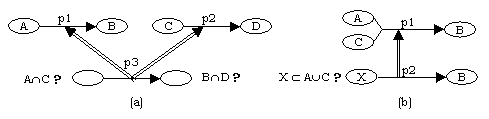
specialization of properties (see Figure 3
-a-), cannot always be ensured because RDF/S do not support intersection
of classes (in a Description Logics style). The second constraint imposes that both
domain and range declarations of a property be unique. This is foremost
required because RDF/S do not support union of classes, which can be
considered as the domain of properties. Furthermore, it is not possible to
infer domains in case of specialization of properties with multiple domains
(see Figure 3 -b-). In this context, the rdfs:Class
definition should be used, in order to define a property with domain or range
all the token resources. Conforming to RDF/S, rdf:Resource should be used as the
domain or range, when we need to define properties viewing schema classes also as
tokens (e.g., rdfs:seeAlso,
rdfs:isDefinedBy,
rdfs:comment,
rdfs:label).
Last, we need to consider an additional constraint of a syntactic nature,
imposing that class and property definitions be complete. This means
that, on the one hand, superclass and superproperty declarations should
accompany the class and property definitions respectively and, on the other
hand, the domain and range of a property should be given along with the
definition of the property. In this manner, the extension of existing RDF
hierarchies of names by refining their classes and properties in a new
namespace is still permitted, while at the same time semantic inconsistencies
that may arise due to arbitrary unions of used hierarchies are avoided. Such
inconsistencies include the introduction of multiple ranges of properties or
the introduction of cycles in class or property hierarchies. Unlike the current
RDF M&S and RDFS specifications [17,
6] this constraint ensures that the union
of two valid RDF hierarchies of names is always valid. The imposed
constraints (C3-C5) are summarized in Table 2 using the notation introduced in this section.
3.2 RDF Typing System
In this context, RDF data can be atomic values (e.g., strings), resource URIs, and container values holding query results, namely rdf:Bag (i.e., multi-sets) and rdf:Sequence (i.e., lists). The main types foreseen by our model are:
t = tL | tU | {t} | [t] | (1:t + 2:t + ... + n:t)
where tL is a
literal type in L, {. } is the Bag type, [.] is the Sequence
type, (.)
is the Alternative type, and tU is the type for resource URIs4. Alternatives capture the semantics of union
(or variant) types [8], and they
are also ordered (i.e., integer labels play the role of union member markers).
Since there exists a predefined ordering of labels for sequences and
alternatives, labels can be omitted (for bags, labels are meaningless).
Furthermore, all types are mutually exclusive (e.g., a literal value cannot
also be a bag) and no subtyping relation is defined in RDF/S (e.g., between
bags of different types). The set of all type names is denoted by T.
The proposed type system offers all the arsenal we need to capture containers
with both homogeneous and heterogeneous member types, as well as, to interpret
RDF schema classes and properties. For instance, unnamed ordered tuples
denoted by [v1, v2, ..., vn] (where vi is of some type ti)
can be defined as heterogeneous sequences5
of type [(t1 + t2 + ... + tn)]. Unlike traditional object data
models, RDF classes are then represented as unary relations of type {tU}
while properties as binary relations of type {[tU, tU]} (for relationships) or {[tU,
tL]}
(for attributes). Furthermore, RDF containers can also be used to represent n-ary
relations (e.g., as a bag of sequences). Finally, assignment of a finite set of
URIs (of type tU) to each class name6 is captured by a population
function p:C 2U.
The set of all values forseen by our model is denoted by V.
Definition 1 The interpretation function [[ . ]] is defined as follows:
- for literal types: [[ L ]] = dom( L);
- for the Bag type, [[ {t} ]] = {v1, v2, ... vn} where v1, v2, ... vn V are values of type t;
- for the Seq type, [[ [t] ]]= [v1, v2, ... vn] where v1, v2, ... vn V are values of type t;
- for the Alt type [[ (t1 + t2 + ... + tn) ]] = vi where vi V 1 < i < n is a value of type ti;
- for each class c C, [[ c ]] = p(c) c' < c [[ c' ]];
- for each property p P, [[ p ]] = { [v1, v2] | v1 [[ domain(p) ]], v2 [[ range(p) ]]} p' < p [[ p' ]].
As usual, the interpretation of classes and properties in our model is
set-based. This implies that a resource URI appears only once in the extent of
a class even when it is classified several times under its subclasses (i.e., it
belongs to the direct extent of the most specific class).
3.3 RDF Description Bases and Schemas
Definition 2 An RDF schema is a 5-tuple RS = (VS, ES, y, l, H), where: VS is the set of nodes and ES is the set of edges, H is a well-formed hierarchy of class and property names H = (N,<), l is a labeling function l: VS ES N T, and y is an incidence function y: ES VS VS.
The incidence function captures the rdfs:domain and rdfs: range
declarations of properties7.
Note that the incidence and labeling functions are total in VS
ES and ES respectively. This does not exclude
the case of schema nodes which are not connected through an edge. Additionally,
we impose a unique name assumption on the labels of RS nodes
and edges.
Definition 3 An RDF description base, instance of a schema RS, is a 5-tuple RD = (VD, ED, y, n, l), where: VD is a set of nodes and ED is a set of edges, y is the incidence function y: ED VD VD, n is a value function n: VD V, and l is a labeling function l: VD ED 2N T which satisfies the following:
- for each node v in VD, l returns a set of names n C T where the value of v belongs to the interpretation of each n: n(v) [[ n ]];
- for each edge e in ED going from node v to node v', l returns a property name p P.
Note that the labeling function captures the rdf:type
declaration that associates each RDF node with one or more class names
(opposite to traditional object models) which may be defined in several
well-formed hierarchies of names. Additionally, integer labels ({ 1, 2, ...}) are
used as property names by the members of RDF container values. The imposed
constraints (C6-C7) are summarized in Table 2 using the notation introduced in this section.

Table 2: Formal definition of imposed constraints
3.4 The
Validating RDF Parser (VRP)
To conclude this
section, we briefly describe the Validating RDF Parser (VRP) we have
implemented to analyze, validate and process RDF descriptions. Unlike other RDF
parsers (e.g., SiRPAC8),
VRP (see Figure 4) is based on standard compiler
generator tools for Java, namely CUP/JFlex (similar to YACC/LEX). As a result,
users do not need to install additional programs (e.g., XML Parsers) in order
to run VRP. The VRP BNF grammar can be easily extended or updated in case of
changes in the RDF/S specifications. VRP is a 100% Java(tm) development
understanding embedded RDF in HTML or XML and providing full Unicode support.
The stream-based parsing support of JFlex and the quick LALR grammar parsing of
CUP ensure good performance when processing large volumes of RDF descriptions.
Currently VRP is a command line tool with various options to generate a textual
representation of the internal model (either graph or triple based).
The most distinctive feature of VRP is its ability to verify the constraints
specified in the RDF M&S and RDFS specifications [17,
6] as well as the additional
constraints we introduced previously (see Table 2).
This permits the validation of both the RDF descriptions against one or more
RDFS schemas, and the schemas themselves. The VRP validation module relies on
(a) a complete and sound algorithm [24] to
translate descriptions from an RDF/XML form (using both the Basic and Compact
serialization syntax) into the RDF triple-based model (b) an internal object
representation of this model in Java, allowing to separate RDF schema from data
information. As we will see in the sequel, this approach enables a fine-grained
processing of RDF statements w.r.t. their type, which is crucial in order to
implement an incremental loading of RDF descriptions and schemas.

4 The RDF
Schema Specific DataBase
This
section describes the persistent RDF store (RSSDB) for loading resource
descriptions in an object-relational DBMS (ORDBMS). We begin by presenting our
schema generation strategy in comparison to other proposals using a monolithic
table [20, 18, 7]
to represent resource descriptions and schemas under the form of triples.
The core RDF/S model is represented by four tables (see Figure 6-A), namely, Class, Property, SubClass and SubProperty
which capture the class and property hierarchies defined in an RDF schema. To
save space when storing class and properties names, we also consider a table NameSpace
keeping the namespaces of the RDF Schemas stored in the ORDBMS. Furthermore, a
table Type
is used to hold the names of RDF/S built-in types (e.g., rdf:Property, rdfs:Class), as
well as, those of Container (e.g., rdf:Bag, rdf:Seq, rdf:Alt) and
Literal types (e.g., string,
integer,
date).
The main novelty of our representation is the separation of the RDF schema from
data information, as well, as the distinction between unary and binary
relations holding the instances of classes and properties. More precisely,
class tables store the URIs of resources while property tables store the URIs
of the source and target nodes of the property. Indices are constructed on the
attributes URI,
source
and target
of the above tables in order to speed up joins and the selection of specific
tuples of the tables. Indices are also constructed on the attributes lpart, nsid and id of the tables
Class
and Property
and on the attribute subid
of the tables SubClass
and SubProperty.
It should be stressed that the taxonomic relationships between schema labels is
captured by the SubClass
and SubProperty
tables, while the corresponding instance tables are also connected through the subtable
relationship, supported today by all ORDBMSs9.
In other words, RSSDB relies on a schema specific representation of resource
descriptions, called SpecRepr, similar to the attribute-based
approach proposed for storing XML data [13,
23]. SpecRepr preserves the
flexibility of RDF in refining schemas and/or enriching descriptions at any
time, and as we will see in the sequel, it can be customized in several ways
according to the specificities of both the manipulated description bases and
the RDF application scenario (i.e., querying functionality).
This is not the case of other proposals employing a monolithic table [20, 18,
7] to represent RDF metadata
under the form of triples. These approaches provide a generic representation
(i.e., for all RDF schemas), called GenRepr, of both RDF schemas and
resource descriptions using two tables (see Figure 6-B), namely, Resources and Triples. The
former represents each resource (including schema classes and properties) by a
unique id whereas the latter represents the statements made about the
resources (including classes and properties) under the form of
predicate-subject-object triples (captured by predid, subid
and objid respectively). Note that in the Triples table we distinguish
between properties representing attributes (i.e., objvalue with literal values) and
those relationships between resources (i.e., objid with URI object values). Indices
(i.e., B-trees) are constructed for all table attributes.
Compared to GenRepr, our SpecRepr is flexible enough to allow
the customization of the physical representation of RDF metadata in the
underlying ORDBMS. This is important since no representation is good for all
purposes and in most real-scale RDF applications variations of a basic
representation are required to take into account the specific characteristics
of employed schema classes and properties. Our main goal here is to reduce the
total number of created instance tables. This is justified by the fact that
some commercial ORDBMSs (and not PostgreSQL) permit only a limited number of
tables. Furthermore, numerous tables (e.g., the ODP catalog implies the
creation of 252840 tables, i.e. one for each topic) have a significant overhead
on the response time of all queries (i.e., to find and open a table, its
attributes, etc.). One of the possible variations we have experimented for the
ODP catalog is the representation of all class instances by a unique table Instances (see
dashed rectangular in Figure 6-A).
This table has two attributes, namely uri and classid, for keeping the uri's of the
resources and the id's of the classes in which resources belong. The benefits
of this SpecRepr variation are illustrated in Section 6 given that most ODP classes (i.e. topics) have few or no
instances at all (more than 90% of the ODP topics contain less than 30 URIs).
For other RDF schemas it could be also interesting to represent in a similar
way all the instances of properties, but in general real-scale RDF schemas have
more classes than properties. Another alternative to our basic SpecRepr
could be the representation of properties with range a literal type, as
attributes of the tables created for the domain of this property. Consequently,
new attributes will be added to the created class tables. The tables created
for properties with range a class will remain unchanged. The above
representation is applicable to RDF schemas where attribute-properties are
single-valued and they are not specialized. Finally, our SpecRepr
opens the way for a more cleaver representation of class and property names
using appropriate encoding systems that preserve the taxonomic relationships of
schema labels and enable to optimize recursive traversals on subclass (or
subproperty) hierarchies.

4.1 The RDF Description Loader

Figure 5
depicts the architecture of our system for loading RDF metadata in an ORDBMS,
namely PostgreSQL10.
The loader has been implemented [4] in
Java and communication with PostgreSQL relies on the JDBC protocol.
The loader comprises two main modules. The first module checks the consistency
of analyzed schemas descriptions in comparison with the stored information in
the ORDBMS. For example, in case that an analyzed property has already been
stored, it checks whether its domain and range are the same as the ones stored
in the ORDBMS. Another functionality of this module is the validation of RDF
metadata based on stored RDF schemas instead of connecting to the respective
namespaces. Thus, we avoid analyzing and validating repeatedly the RDF schemas
used in metadata and reduce the required main memory, since only parts of RDF
schemata are fetched. Consequently, our system enables incemental
loading of RDF descriptions and schemas, which is crucial for handling large
RDF schemas and even larger RDF description volumes created using multiple
schemas.
The second module implements the loading of RDF descriptions in the DBMS. To
this end, a number of loading methods have been implemented as member functions
of the related VRP internal classes. Specifically, for every attribute of the
classes of the VRP model, a method is created for storing the attribute of the
created object in the ORDBMS. For example, the method storetype is
defined for the class RDF_Resource,
in order to store object type information. The primitive methods of each class
are incorporated in a storage method defined in the respective class invoked
during the loading process. A two-phase algorithm is used for loading the RDF
descriptions. During the first phase, RDF class and properties are stored to
create the corresponding schema. During the second phase the database is
populated with resource descriptions.
5 Querying RDF Description Bases
As shown in Table 1, the catalog of Portals like Netscape Open Directory
comprises huge hierarchies of classes and an even bigger number of resource
descriptions. It becomes evident that browsing such large description bases
is a quite cumbersome and time-consuming task. Consider, for instance, that we
are looking for information about hotels in Paris, under the topic Regional of ODP (see Figure 2). ODP allows users to navigate through the topic
hierarchy; as shown in Table 1, even if one knows the
exact path to follow, this would require approximately 8 steps, in order to
reach the required topics (i.e., Hotels, Hotel Directories in Figure 2). Then, in order to find the URIs of the sites
whose title or description matches the string "*Opera*", users are
forced to manually browse the entire collection of resources directly
classified under the topic of interest. Note that, in order to locate resources
classified under the subtopics (e.g., Hotel
Directories) of a given topic, browsing should be continued by the
users. RQL aims to simplify such tasks, by providing powerful path
expressions permitting smooth filtering/navigation on both Portal schemas and
resource descriptions. Then the previous query can be expressed as follows:
Q: Find the resources under the hierarchy Regional, about hotels in
Paris whose title matches "*Opera*".
|
select |
Z |
|
|
from |
(select |
$X |
|
|
from |
Regional{:$X} |
|
|
where |
$X like "*Hotel*" |
|
|
|
and $X < Paris){Y}.{Z}title{T} |
|
where |
T like "*Opera*" |
|
The schema path expression
in the from clause of the nested query, states that we are interested in
classes (variables prefixed by $ like $X) specializing the root Regional. Then, the filtering condition in the
where clause will retain only the classes whose name matches
"*Hotel*" and they are also subclasses of Paris
(e.g., Hotel and Hotel Directories. Here, to get all relevant
topics, the only required schema knowledge is that the subtopics of Regional contain geographical information and a
topic Paris is somewhere in the
hierarchy. Thanks to RQL typing, variable Y is of type class name and
ranges over the result of the nested query. The data path expression
in the outer query iterates over the source (variable Z of type resource
URI) and target values (variable T of type resource URI) of the title
property. The ``.''
implies an implicit join condition between the extent of each class valuating Y
and the resources valuating Z. Finally, the result of Q will be a
bag of resources whose title value matches "*Opera*". Obviously, RQL
schema queries are far more powerful
than the corresponding topic queries
of common portals, which allow only full-text queries on the names of topics.
Furthermore, compositions of schema and data
queries like Q, are not possible in current portals, since
one cannot specify that some query terms should match the topic names and other
should be found in the descriptions of the resources.
To make things more complex, relevant information in portals may also be found
under different hierarchies, that may be ``connected'' through related links. For example, as we can see in
Figure 2, information about hotels in
Paris may also be found in the Recreation
hierarchy. Moreover, such links are not necessarily bi-directional; thus, a
user starting from the Regional
hierarchy may never find out that similar information may be found under Recreation e.g., Vacation-Rentals.
For such cases, RQL path expressions allow us to navigate through
schemas as for example, {:$Z}related.Regional{:$X}.
The above examples illustrate a unique feature of RQL, namely that RQL
provides the ability to smoothly switch between schema and data querying while
exploiting - in a transparent way - the taxonomies of labels and multiple
classification of resources (unlike logic-based RDF query languages, e.g.,
SiLRI [11], Metalog [19]). More examples on RQL can be
found in [14].
5.1 RQL Interpreter
The RQL interpreter, implemented in
C++, consists of (a) the parser, analyzing the syntax of queries; (b) the graph
constructor, capturing the semantics of queries in terms of typing and
interdependencies of involved expressions; and (c) the evaluation engine,
accessing RDF descriptions from the underlying database [16]. Since our implementation relies on
a full-fledged ORDBMS like PostgreSQL, the goal of the RQL optimizer
is to push as much as possible query evaluation to the underlying SQL3 engine.
Then pushing selections or reordering joins to evaluate RQL path
expressions is left to PostgreSQL while the evaluation of RQL functions
for traversing class and property hierarchies relies on the existence of
appropriate indices (see Section 6). The main difficulty
in translating an entire RQL algebraic expression (expressed in an
object algebra a la [10]) to a single
SQL3 query is due to the fact that most RQL path expressions interleave
schema with data querying [9]. This
is the case of the query Q presented previously.
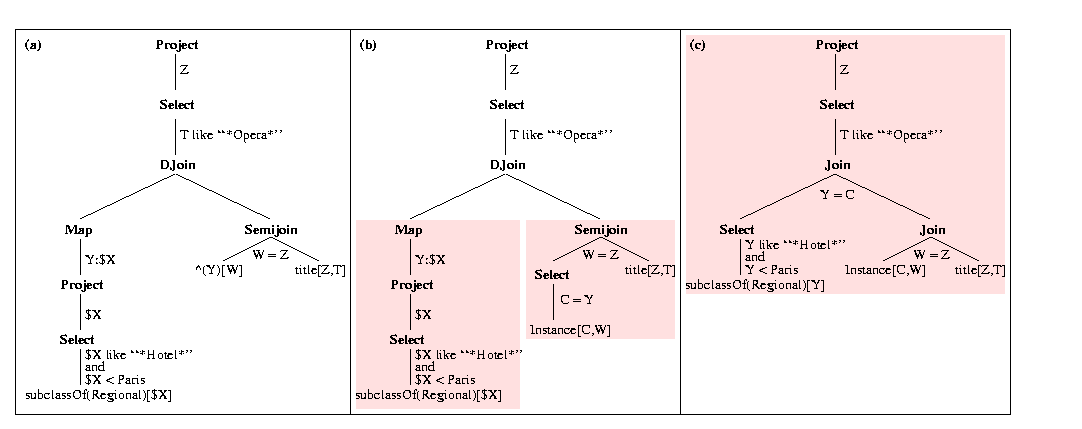
Figure 7 (a) illustrates the algebraic
translation of Q. The translation of the nested query - given in the
left branch - is rather straightforward: the class variable $X over all
the subclasses of Regional and its
values are filtered according to the conditions in the where clause. The
operator Map
on top is a simple variable renaming for the iterator (Y) defined over
the nested query result. Then, the data path expression in the from clause is
translated into a semi-join between the source-values of title and the proper instances of the class
extents (W) returned by the nested query, as shown in the right branch.
The connection between the two expressions is captured by a Djoin operation
(i.e., a dependent join in which the evaluation of the right expression depends
on the evaluation of the left one). Djoin corresponds to a nested loop
evaluation with values of variable Y passed from the left-hand side
(i.e., nested query) to the right-hand side. Using the database representation,
we can substitute the scan operation on class instances (^(Y)[W])
with a selection on the Instances
relation, as shown in Figure 7 (b). Then, each
of the subqueries in the shadow boxes can be pushed down to PostgreSQL, leaving
the evaluation of the Djoin
to the interpreter. However, transforming the semijoin on the right into a join
and pushing the selection criterium C=Y up to the Djoin operation
leads to the evaluation plan shown in Figure 7
(c). As one can see, the whole query is expressible in SQL3 (subclassof and issubclassof are
procedural SQL functions) as follows:
|
select |
Z.source |
|
from |
subclassesof(Regional) Y, Intances I, title* Z |
|
where |
issubclassOf(X, Paris) and X like ``*Hotel'' and |
|
|
I.classid=Y and Z.source=I.uri and |
|
|
Z.target like ``*Opera*'' |
Note that the *
indicates an extended interpretation of tables, according to the subtable
hierarchy. Thus, the whole query can be pushed down to PostgreSQL, and the
PostgreSQL optimizer can perform on further (common) optimizations, as pushing
down selections, join reordering etc.
6 Performance Tests
In order to evaluate the performance
of the two representations, we used as testbed the RDF dump of the Open
Directory Catalog (version of 16-01-2001). Experiments have been carried out on
a Sun with two UltraSPARC-II 450MHz processors and 1 GB of main memory, using
PostgreSQL (Version 7.0.2) with Unicode configuration. During loading and
querying, we have used 1000 and 10000 buffers (of size 8KB) respectively. We
have loaded 15 ODP hierarchies (see Table 1) with
a total number of 252825 topics (i.e., classes) contained in 51MB of RDF/XML
files11. For these hierarchies, we have also loaded
the corresponding descriptions of 1770781 resource URIs (672MB).
6.1 Loading
The leftmost
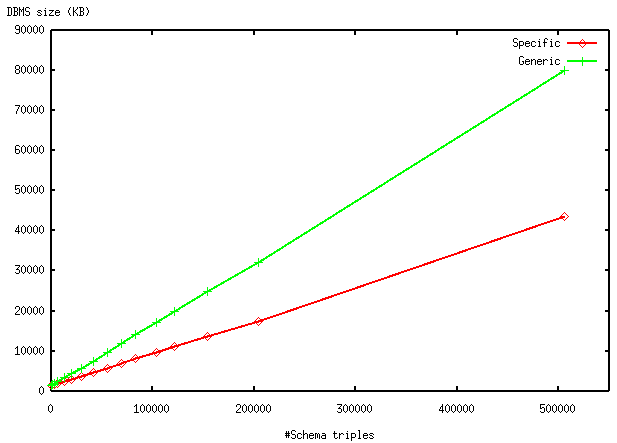
graph of Figure 8 depicts the database size
required to load the ODP schema and resource descriptions measured in terms of
triples in the schema-specific (SpecRepr) and in the generic (GenRepr)
representation schemes. Note that to each class definition correspond two
triples: one for the class itself and one for its unique superclass (multiple
class specialization is not used in the ODP Catalog). We can observe that in
both representations the size of the DBMS scales linearly with the number of
schema triples. The tests show that, in SpecRepr, each schema triple
requires on average 0.086KB versus 0.1582KB in the GenRepr.
This is mainly attributed to the space saved in SpecRepr due to the Namespace table,
as well as to the fact that for each class definition in GenRepr three
tuples are stored: one in table Resources and two tuples in table Triples (i.e.,
1770781 extra tuples). Although not illustrated here, the average time for
loading a schema triple is about 0.0021 sec and 0.0025 sec
respectively in the two representations. The time required to store a schema
triple is larger in GenRepr because of extra (252825) tuples stored.
When indices are constructed, the average storage volumes per schema triple
become 0.1734KB (SpecRepr) and 0.3062KB (GenRepr)
and the average loading times become 0.0025 sec and 0.00317 sec
respectively. The total validation time for the ODP schema is 1539 sec.
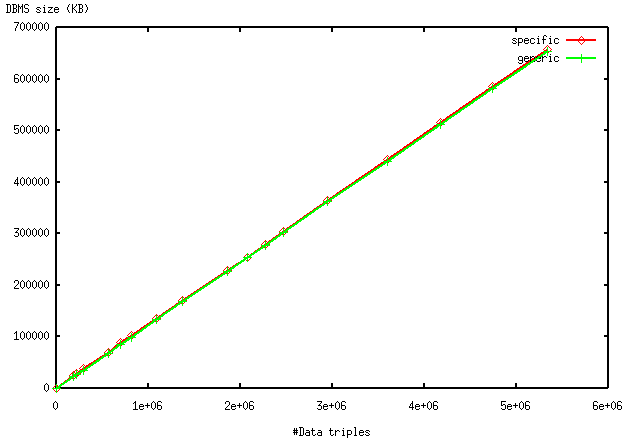
The database size required for the resource descriptions is shown in the
rightmost graph of Figure 8. As expected, the
DBMS size in both representations scales linearly with the number of data
triples. The average space required to store a data triple is 0.123KB
in both representations. This should not appear as a surprise since the extra space
required in SpecRepr for storing the URIs of resources in the property
tables compensates for the extra tuples stored for each resource description in
GenRepr. Note that we could obtain better storage volumes in the SpecRepr
by encoding the resource URIs as integers, as we did in the GenRepr,
but this solution comes with extra loading and join costs (between the class
and property tables) for the retrieval of the URIs. The tests also show that
the average time for loading a data triple is about 0.0033 sec and 0.0039
sec respectively in the two representations. When indices are constructed,
the average storage volumes per data triple become 0.2566KB (SpecRepr)
and 0.2706KB (GenRepr) while the average loading time become 0.0043
sec and 0.00457 sec respectively. Despite the use of ids, the
indexes in GenRepr take up more space because of: a) the extra tuples
stored b) the index constructed on the predid attribute for which there is no
corresponding index in SpecRepr.
To summarize, after loading the entire ODP catalog, the size of tables in GenRepr
is 545MB for Triples
(5835756 tuples), 202MB for Resources
(2022869 tuples) and the total size of indexes on these tables is 900MB. In SpecRepr,
the size is 32MB for Class
(252825 tuples), 8KB for Property
(5 tuples), 11MB for SubClass
(252825 tuples) and 0MB for SubProperty,
and the total size of indexes on these tables is 44MB. The size of the Instances table
is 150MB (1770781 tuples) whereas the size of indexes created on it is 140 MB.
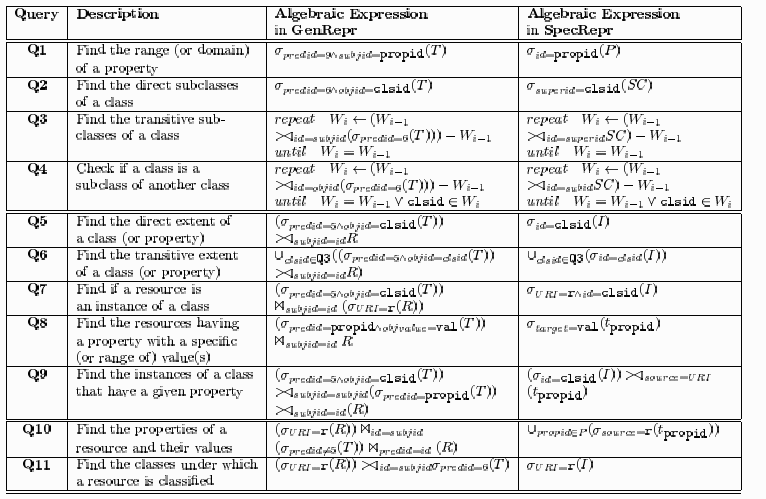
Table 3: Benchmark Query Templates for RDF description bases
6.2 Querying
Table 3 describes the RDF query templates that we used
for our experiments, as well as their respective algebraic expressions in the
two representations (capital letters abreviate the table names of Figure 6). This benchmark illustrates the desired
querying functionality for RDF description bases, namely: a) pure schema
queries on class and property definitions (e.g., Q1-Q4); b) queries on resource
descriptions using available schema knowledge (e.g., Q5-Q9); and c)
schema queries for specific resource descriptions (e.g., Q10, Q11). As a
matter of fact, these query templates depict the core functionality of RQL
presented in the previous section.
To get significant experimental results, we carried out all benchmark queries
several times: one initially to warm up the database buffers and then nine
times to get the average execution time of a query. Table 4 illustrates the obtained execution time (in
sec) for both representations in up to three different result cases per query.
The main observation is that SpecRepr outperforms GenRepr for
all types of queries considered. The deviation in performance is more apparent
in the cases where self-join computations on the large Triples table
are required.
GenRepr and SpecRepr exhibit comparable performance in
queries Q1, Q2,
Q5, Q7, Q10 and Q11,
with SpecRepr outperforming GenRepr by a factor of up to 3.73
approximately. This is clearly illustrated in Q1, where one tuple is selected from
both table Triples
(selectivity 1,7e-5%) and Property
(selectivity 20%) using index and sequential scans respectively. As expected,
in Q2,
we can see that the time required to filter a table in both representations
depends on the number of tuples in the query results: we have experimented with
classes having 1, 30, 314 subclasses which represent in GenRepr (SpecRepr)
selectivities of 1.7e-5% (3.955e-4%), 5.14e-4% (1,19e-2%) and 5.38e-3% (0.124%)
for table Triples
(SubClass)
in the three cases respectively. The (semi-)joins involved in the evaluation of
queries Q5,
Q7 and
Q11
incur an additional cost for GenRepr, whereas in Q10 the join
cost (for GenRepr) is comparable to the cost of evaluating set union
(for SpecRepr).
Queries Q3,
Q4 and
Q6
involve a transitive closure computation (using a variation of the d-wavefront algorithm [21]) over the subclass hierarchy. SpecRepr
outperforms GenRepr by a factor of up to 2.8. In Q3 and Q6, we use the
same three classes having 3, 30 and 3879 subclasses and a total of 2, 20 and
9049 instances respectively. The execution times in these three cases depend on
the sizes of intermediate results (i.e., the costs of joins involving the
tables Triples
or SubClass)
as well as, the number of iteration steps of the algorithm (i.e., the length of
the longest path from the given class to its leaves, called depth). In
Q4,
for the same root class, we have checked for subclasses residing at depth 3, 5
and 7 respectively. The difference in the obtained times between Q3, Q6 and Q4 is due to the
different evaluation method used: "top-down" for the former (i.e.,
from the sub-tree root to the leaves) and "bottom-up" for the latter.
In the case of queries Q8
and Q9
SpecRepr exhibits a much better performance than GenRepr. GenRepr
reaches its limits when table Triples needs to be self-joined (here PostgreSQL
uses a hash join algorithm), whereas in SpecRepr, a join between two
small tables suffices to be evaluated as expected. Specifically, SpecRepr
outperforms GenRepr by a factor ranging from 1753 up to 95538. Note
that GenRep will suffer similar performance limitations in the
evaluation of queries involving complex path expressions (e.g., in more
sophisticated schemas than in the case of the ODP catalog) which will
essentially result in a number of self-joins of table Triples. Query Q8 has been
tested for value ranges returning 1, 10 and 40 resources respectively. In SpecRepr,
its evaluation involves index scans on the property table, whereas in GenRepr
different evaluation plans are executed in each case. Q9 has been
tested for three properties with 6292, 52029 and 1770584 instances
respectively.
|
Query |
Generic |
Specific |
|||||||||||||||||||||||||||||||||||||||||||||||||||||||||||||||||||||||||||||
|
|
|
|
|||||||||||||||||||||||||||||||||||||||||||||||||||||||||||||||||||||||||||||
|
|
|
Table 4: Execution Time of RDF Benchmark Queries
To summarize, SpecRepr
outperforms GenRepr, which - in the case of complex path expressions -
pays a severe performance penalty for maintaining large tables. We argue that
the performance of SpecRepr can be further improved by emplying an appropriate
encoding system (e.g., Dewey, postfix, prefix, etc.) that preserves the
taxonomic relationships of schema labels. In this way, checking subclass
relationships can be done in constant time. We believe that this approach will
prove to be quite useful, not only for RDF, but for tree-structured data, such
as XML [2].
7 Summary
In this paper we
presented the architecture and functionality of ICS-FORTH RDFSuite, a suite of
tools for RDF metadata management. RDFSuite addresses a notable need for RDF
processing in Web-based applications (such as Web portals) that aim to provide
a rich information content made up of large numbers of heterogeneous resource
descriptions. It comprises efficient mechanisms for parsing and validating RDF
descriptions, loading into an ORDBMS as well as query processing and
optimization in RQL. We also presented a formal data model for RDF
metadata and defined a set of constraints that enforce consistency of RDF
schemas, thus enabling the incremental validation and loading of voluminous
description bases. We argue that, given the immense volumes of information
content in Web Portals, this is a viable approach to providing persistent
storage for Web metadata. By the same token, efficient access to information in
such Portal applications is only feasible using a declarative language
providing the ability to query schema and data and to exploit schema
organization for the purpose of optimization. We also reported on the results
of preliminary tests conducted for assessing the performance of the loading
component of RDFSuite. These results illustrate that the approach followed is
not only feasible, but also promising for yielding considerable performance
gains in query processing, as compared to monolithic approaches.
Current research and development efforts focus on studying the transactional
aspects of loading RDF descriptions in an ORDBMS, as well as, the problem of
updating or revising description bases. A detailed analysis of query
optimization using alternative representation schemes is underway. Furthermore,
appropriate index structures for reducing the cost of recursive querying of
deep hierarchies need to be devised as well. Specifically, an implementation of
hierarchy linearization is underway, exploring alternative node encodings.
Last, but not least, we intend to extend our formal data model to capture
higher-order aspects such as statement reification.
References
S. Abiteboul, P. Buneman, and D. Suciu. Data on the Web: From Relations to Semistructured Data and XML. Morgan Kaufmann, 1999.
S. Abiteboul, H. Kaplan, and T. Milo. Compact labeling schemes for ancestor queries. In 12th Symposium on Discrete Algorithms, 2001.
Serge Abiteboul, Richard Hull, and Victor Vianu. Foundations of Databases. Addison-Wesley, 1995.
S. Alexaki. Storage of RDF Metadata for Community Web Portals. Master's thesis, Univ. of Crete, 2000.
G. Beged-Dov et.al. RSS 1.0 Specification Protocol. Draft, August 2000.
D. Brickley and R.V. Guha. Resource Description Framework (RDF) Schema Specification 1.0, W3C Candidate Recommendation. Technical report, , 2000.
D. Brickley and L. Miller. Rdf, sql and the semantic web - a case study. Available at ilrt.org/discovery/2000/10/swsql/.
L. Cardelli. A semantics of multiple inheritance. Information and Computation, 76(2/3):138--164, 1988.
V. Christophides, S. Cluet, and G. Moerkotte. Evaluating Queries with Generalized Path Expressions. In Proc. of ACM SIGMOD, pages 413--422, 1996.
S. Cluet and G. Moerkotte. Nested Queries in Object Bases. In DBPL'93, pages 226--242, 1993.
S. Decker, D. Brickley, J. Saarela, and J. Angele. A query and inference service for rdf. In W3C QL Workshop, 1998.
C. Finkelstein and P. Aiken. Building Corporate Portals using XML. McGraw-Hill, 1999.
D. Florescu and D. Kossmann. A performance evaluation of alternative mapping schemes for storing xml data in a relational database. Technical Report 3680, INRIA Rocquencourt, France, 1999.
ICS-FORTH. The ICS-FORTH RDFSuite web site. http://www.ics.forth.gr/isl/RDF, 2001.
ISO. Information Processing-Text and Office Systems- Standard Generalized Markup Language (SGML). ISO 8879, 1986.
G. Karvounarakis. A Declarative RDF Metadata Query Language for Community Web Portals. Master's thesis, University of Crete, 2000.
O. Lassila and R. Swick. Resource Description Framework (RDF) Model and Syntax Specification, W3C Recommendation. Technical report, , 1999.
J. Liljegren. Description of an RDF database implementation. Available at WWW-DB.stanford.edu/~melnik/rdf/db-jonas.html.
M. Marchiori and J. Saarela. Query + metadata + logic = metalog. In W3C QL Workshop, 1998.
S. Melnik. Storing RDF in a relational database. Available at http://WWW-DB.stanford.edu/~melnik/rdf/db.html.
G. Qadah, L. Henschen, and J. Kim. Efficient Algorithms for the Instantiated Transitive Closure Queries. IEEE Transactions on Software Engineering, 17(3):296--309, 1991.
Some proposed RDF APIs.
GINF, RADIX, Mozzila, Jena, Redland: www.w3.org/RDF/Interest.
F. Tian, D. DeWitt, J. Chen, and C. Zhang. The Design and Performance Evaluation of Alternative XML Storage Strategies. Technical report, Univ. of Wisconsin, 2000.
K. Tolle. ICS-Validating RDF Parser: A Tool for Parsing and Validating RDF Metadata and Schemas. Master's thesis, University of Hannover, 2000.
S. Weibel, J. Miller, and R. Daniel. Dublin Core. In OCLC/NCSA metadata workshop report, 1995.
Web service description language www106.ibm.com. /developerworks/library/ws-rdf, 2000.
This work was partially supported by the EC project C-Web (IST-1999-13479) and Mesmuses (IST-2000-26074).
www.dmoz.org, home.cnet.com, www.xmltree.com respectively.
We will not treat reification in this paper.
The symbol extends < with equality.
In Section 5, we will see that our query language treats URIs, i.e., identifiers, as simple strings.
Observe that, since tuples are ordered, for any two permutations i1,...,in and j1, ..., jn of 1,...,n, [i1:v1, ..., in:vn] is distinct from [j1:v1, ..., jn:vn].
Note that we consider here a non-disjoint object id assignment to classes due to multiple classification.
Constraint C4 of Table 2 ensures that rdfs:domain and rdfs:range are not any more relations as in the current RDF M&S and RDFS specifications [17, 6].
www.w3.org/RDF/Implementations/SiRPAC
Note that the syntactic constraint (see Section 3) imposing complete class and property definitions, ensures that the table hierarchy created in RSSDB can be only extended through specialization
This is the volume of the pure ODP schema, produced when properties attributed to the classes are removed.
This document was translated from LATEX by HEVEA.